
If anyone has listed to me ramble on about the quality control issues that have plagued Remington rifles for the past two decades, they’d be shocked to know I’ve owned fifteen Remington rifles of various calibers and configurations. On one hand, the most accurate rifle I own is a more recent production Remington 700P in 300 Winchester Magnum, but it took a considerable amount of coin and time invested to make it so. On the other hand, the most inaccurate hunting rifle I own is 70 years old, a 722 in 300 Savage. That damn rifle, for all my fondness in possessing my fathers first hunting rifle, couldn’t hit the broad side of a barn from inside it. This is likely because it sat inside a screwed shut foot locker for about 30 years, causing some bore issues that have been the devil to resolve.
If you were to pull my 1981 Remington 700 ADL in 7mm Express Remington (also known as .280 Remington) from the safe, you’d be tickled by it’s rich, deep bluing and smooth action. I’ve owned some great rifles, both factory guns and custom shop ones, but this one is one hell of a gorgeous rifle. It’s quality is representative of an era when Remington cared about their reputation, and wasn’t turning out dozens of factory configurations of the same rifle. It’s my belief that over-producing and military contracts led to an arrogance that is common amongst gun manufacturers that seek to rest on their laurels. That, and some poor business decisions really hammered Remington over the last decade, leading in no small part to their eventual bankruptcy and sale.
That said, the basic concept of the “3 rings of steel” lends itself to tremendous inherent accuracy when dimensions are well seen to. When it was first marketed, the Remington 700 was competing against mostly controlled-feed Mauser type actions such as the Winchester Model 70 and surplus military Mauser rifles reconfigured for hunting. It’s push feed design came with a simplicity that enabled accurate and precise shooting. This is why the Remington 700 eventually replaced every bolt action sniper rifle in the U.S. Military, whether as the M24 and eventually the M2010 in the Army or the M40 series in the Marine Corps. Along with the martial use of the basic Remington 700 action, it has also become the basis for most custom actions geared toward the precision shooting community.
I say all this to say; the Remington 700 has all the trappings of a great rifle, when it’s properly built and all it’s faults treated with proper aftermarket solutions. Things like stocks, triggers, barrels, and extractors are all possible replacements to make these rifles into accurate, dependable arms. Personally, the two most significant weaknesses are the trigger design and the extractor. I know a lot has been made of the faults of the 700 trigger, and I am inclined to believe the necessary remedies have been found, but lord almighty I cannot bring myself to trust them. The extractor has long been an issue and I have broken two so far. There are better designs out there that can be added, the M16 style and Sako designs being two. Everything else more or less comes down to the purpose of the rifle and the needs of moment, along with personal preference. Some people prefer lightweight barrels and stocks, brakes and detachable box magazines. Some of these things can makes the 700 more accurate, while others are purposeful additions the shooter desires to simplify the purpose of the rifle.
While I have a lot of rifles, I have a gap in my capabilities that I need to fill, if only for my own OCD. Several years ago I purchased a Remington 700 LTR, a short barrel 308 that had some action work done and a quality bolt handle. Although I liked the shorter barrel for working in confined spaces, I wanted a 6.5 Creedmore precision rifle more. So, I ordered a barrel and sent it over to my gunsmith, leaving me without a short barreled precision rifle. This became even more apparent when I finished my 300 Winchester Magnum, with it’s 27.25 inch barrel. That rifle is a behemoth, heavy and difficult to move. A smaller rifle would allow me to shoot from smaller, more confined areas while packing a lighter rig to shoot longer distances.
So when I found a Remington 700 SPS Tactical on a local forum, and for an incredibly cheap price with a decent optic for hunting, I jumped at the chance to fill that gap. This particular example of that line has only had five rounds shot through it’s barrel, and the optic is brand new. That said, the stock is hot-garbage, a Hogue overmold stock that isn’t known for it’s attributing to accuracy, over torqued and making 20% contact on both the front and rear pillars. The finish was already rusting, a monument to the terrible corners that were cut when building these rifles. Why they ever thought that finish would be durable is beyond me. To cap it all off, the bases and the Warne optic rings were over torqued like the stock was, and quite frankly I’ve never felt such a rough action in my life. I most definitely have my work cut out for me.
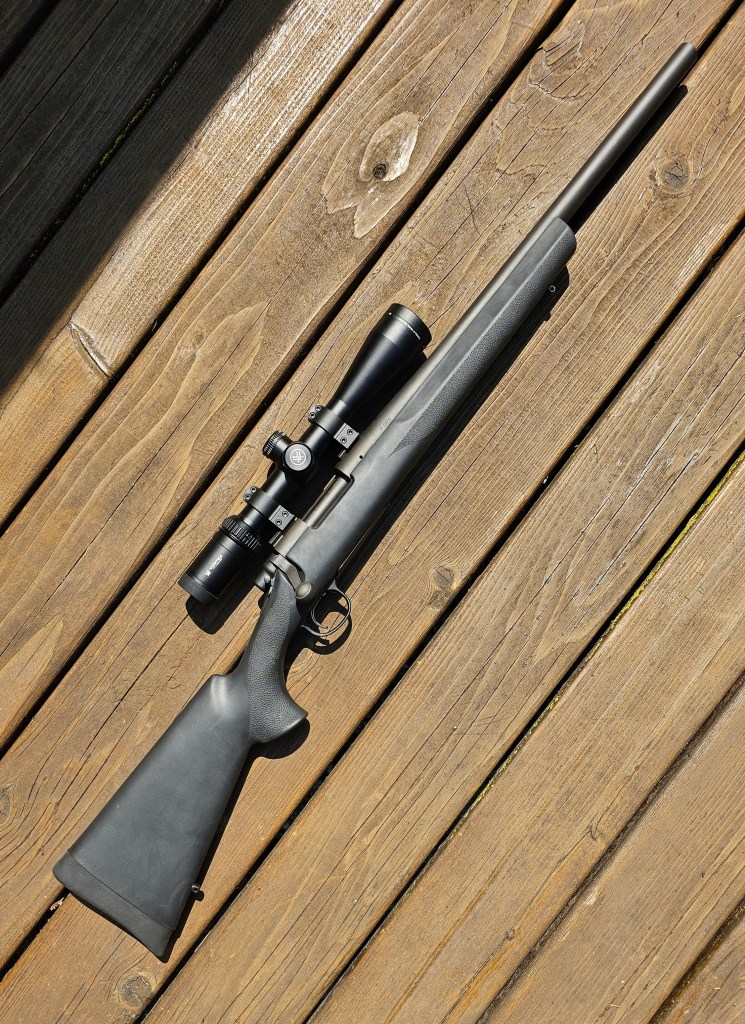
Before attempting any sort of base accuracy test, I stripped the rifle down and gave it a through cleaning. I then filed the stock pillars to make greater contact with the action and retorqued to spec. Then the scope, rings, and 2 piece bases came off and were replaced with a 20 MOA Leupold base, Hawkins Heavy Tactical 34mm scope rings and a Vortex Strike Eagle II 5-25x56mm optic that has been on a few other rifles previously. I felt these were the minimum replacements I should make, so as to not waste valuable 175g Federal Gold Medal Match rounds in a losing effort. At my next range day I will fire five 9-shot groups to determine relative accuracy before replacing the stock and bottom metal, along with truing up the action and bolt face to the best of my ability.

Should this work, and the rifle achieve a 3/4 MOA accuracy minimum through the factory barrel, I will likely have it threaded for a suppressor and the barreled action Cerakoated prior to calling it quits on this project. My hope is to continue to post updates here and share my observations with the one or two of you that read this sort of thing. Thanks for sticking around through a length write up!
 The North Fork Rendezvous