
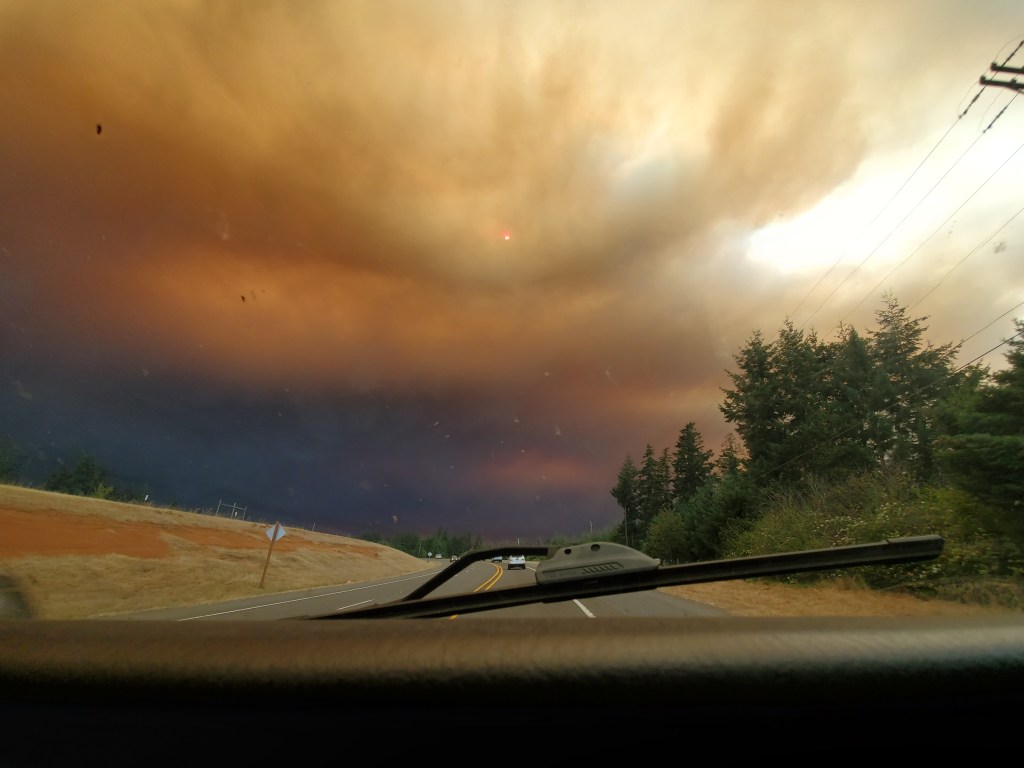
Holy fuck if 2020 couldn’t get any less crazy, September rolled around and brought with her a clusterfuck of mammoth proportions.
Wildfires are to the Western States what hurricanes are to our southern brethren. The key difference is while hurricanes are a completely natural occurrence and the south has the benefit of weather forecasting and modeling to determine when and where it will hit and with what intensity, wildfires can spring up in a day and threaten everything near them. Yes, these fires are effected by local weather patterns and geographical features, the thing that makes them so unpredictable is the inherent craziness of fire itself. This became apparent to many of us in the southern portion of Clackamas County, a rural part of Oregon characterized by deep federal, state, and private timberlands when two massive wildfires and several smaller ones threatened thousands of homes and businesses last September.
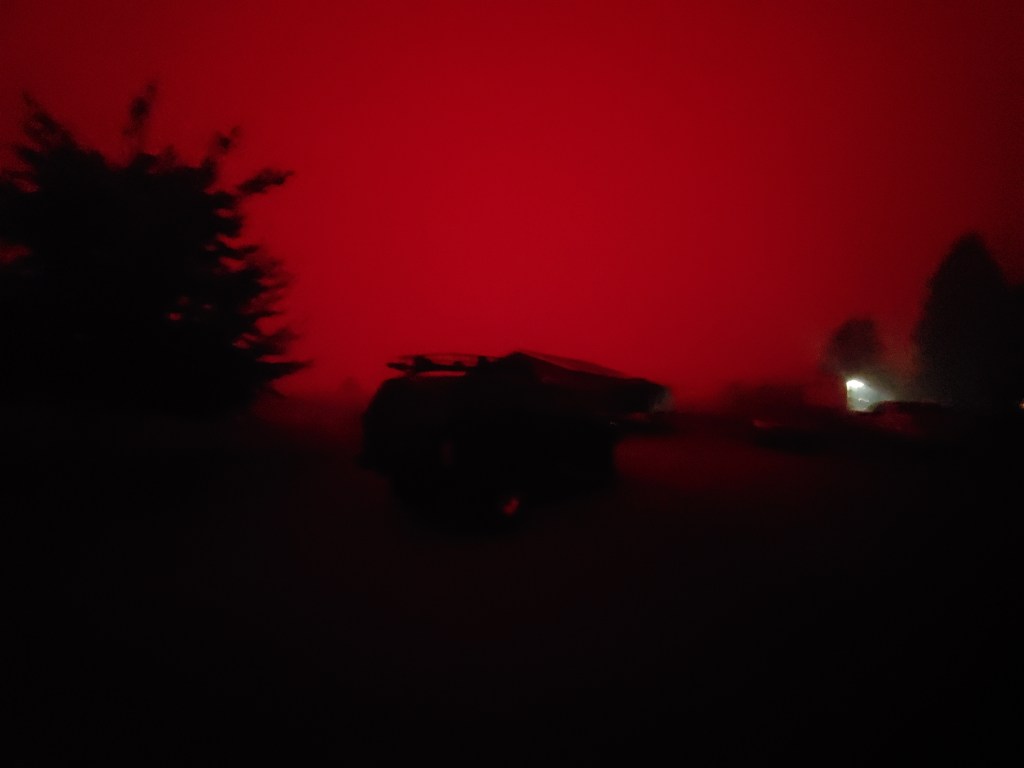
I will be the first to admit I am not an expert on the science of fires, I’m just some dumb schmuck who found himself living his life when wildfires threatened my home and family. That said, this is geared toward the lessons learned over the course of a week of improvisation and failure. I’m hoping to pass on the things I learned so that maybe someone who reads this finds themselves ahead of where I was when the world turned red.
Situational Awareness
This is applicable to literally any major catastrophe. Anyone who has been in the military understands the concept of situational awareness (SA). It’s basically knowing what is going on around you, and in the context of this article it’s knowing current and emerging threats to personal safety and property.
I believe the night of the 8th was the night we evacuated. The reason we did was a fire popped up roughly 500 meters from the property line that looked to me at the time to be caused by some sort of a car accident. Prior to evacuation, the smell of smoke was overwhelming and it blocked out any natural light sources, thus limiting my ability to gain sensory information via my shit brown vision balls. However, I heard a rumor that there was a fire a short distance away so I hopped in my Jeep and went to investigate. Sure enough, I was greeted by explosions shooting flame eighty feet in the air and immediately felt bamboozled.
Why bamboozled? I had no idea what had been occurring 500 meters from my residence. I assumed all the nearby smoke was coming from the Riverside Fire originating in the Fish Creek Drainage near Estacada. While I wasn’t even slightly aware of where that fire was, I didn’t even know about the one that was the immediate threat to my family and I. In a crisis, a simple drive around my local area a mile up the road both ways could have taught me a lot about what was going on in the vicinity. I should have taken that opportunity earlier, before it got dark, and continued until the situation changed.
TL;DR: Recon is your friend, don’t miss an opportunity to see things with your own eyes.
Go Gear
A lot of people have really bought into the idea of a “go-bag” with things like water purification tablets, matches, food, ammo, and other “necessities” for survival. While this isn’t a bad thing and I highly recommend that everyone assemble these bags to grab in case of emergency, in the case of wildfires there is some other things to grab incase of evacuation.
Having important documents, family keepsakes, and other easy to move valuables assembled in such a way that they are easy to grab is really important. When I left the house, all of my documentation from the military was still there. Some of that stuff I have no copies of, so having it and other important documents kept together in an organized fashion is a must.
Also, having an axe (or pulaski), shovel, and mattock pick ready isn’t a bad idea incase you find yourself needing hand tools to solve fire related problems. A decent chainsaw also helps in this regard to removed downed trees and debris from roads. Even better, a winch attached to your vic can help you pull other vehicles or debris wherever you need them to be. Be sure to practice before hand and have a firm grasp of how to use these tools.
Basic necessities like cash, spare clothing, hygiene items, and medications should be obvious. Cash draws strange looks from people when you mention it as necessary for survival, some think precious metals are the only thing that will be used when electronic systems go down but in situations like the fires, cash may be the only thing businesses near the emergency may take. I think these are the most obvious things to have with you, considering this isn’t a “end of civilization” situation that values bullets and beans over toothpaste and deodorant.
Rally Points
My brother in law deserves the credit for emphasizing this. Having prearranged rally points is key if your local cell service is out and you have no other means to contact family or friends you may want to link up with. I would advise using the acronym P.A.C.E, or Primary/Alternate/Contingency/Emergency as a way to establish primary, secondary, and tertiary rally points as well as scouted routes to those destinations. These rally points could be homes belonging to family and friends, or large well lit parking lots at stores.
A timeline should accompany these rally points so that your network of family and friends will know when and where you will be in an emergency that makes our normal methods of communication impossible. In situations like the fires where communication was easy but travel via local roads out of the evacuation zone was not, being able to push out a key word that tells your network “I am leaving my residence and proceeding to Rally Point Alpha” can be the difference between a widely understood plan and a miscommunicated intent in a time where things are happening quickly.
Rumors
This one drove me fucking bonkers.
There was a metric fuck-ton of rumors going around about the origins of the fires and alleged ne’er-do-wells burglarizing evacuated homes. These rumors spread via social media and were most often consisting of claims that a certain political movement that most of the local area despises was starting these fires, and all of these rumors lacked one critical thing: evidence. That didn’t stop some people from believing them, and while I didn’t fall for it, there were a great many who bought it hook line and sinker.
Why is this important? These rumors led to citizens near the evacuation zone, especially in my home town, forming a sort of neighborhood patrol to keep an eye on homes and to look out for arsonists. There were even instances of roadblocks checking ID’s to verify those people being stopped “belonged” in the area. While this may appear honorable at first glance, it creates a friction point for conflict. What happens when someone is stopped and doesn’t have the required documentation to prove they are from the area? How can they prove their purpose is genuine? What about when family members looking after the homes and property of their evacuated kin are stopped and are deemed to be up to no good by the people manning these roadblocks?
Tension is ratcheted up by rumors, as is the willingness by some to act as neighborhood police despite the massive amount of law enforcement in the evacuation area. I saw 22 law enforcement vehicles from all sorts of departments parked at a grocery store in Molalla on the 10th of September, as well as many vehicles patrolling the roads in and out of town. These ad-hoc patrols by citizens were not only unnecessary, but lacking in legal authority or the trust inherent to badged law enforcement when interacting with the average citizen. My own experience seeing a truck load of armed men driving through a neighborhood while I checked on a buddy’s home had me clutching my Glock and making sure my rifle was within reach if need be.
Be mindful of outlandish rumors are your own bias which may lead you to believe such rumors. Be skeptical of so called “evidence” like video and photographs posted to social media that have a biased spin to them. Pay no heed to propagandists, at national media organizations or your home town Facebook page who tell you who your enemy is and appeal to your emotional bias against things you disagree with. This should be common sense, but it seems that even county Sheriffs fail to act like adults in an emergency and push disinformation, as we saw in Clackamas County.
In Conclusion
I hope something in this resonated with you, or helped spur on some though process that will enable you to better prepare for emergencies in the future. Remember, many of these things apply across all emergency situations we may encounter. Take the time to set yourself up for success, and recognize that mental and physical strength will help you more than a cool piece of kit will.
 The North Fork Rendezvous